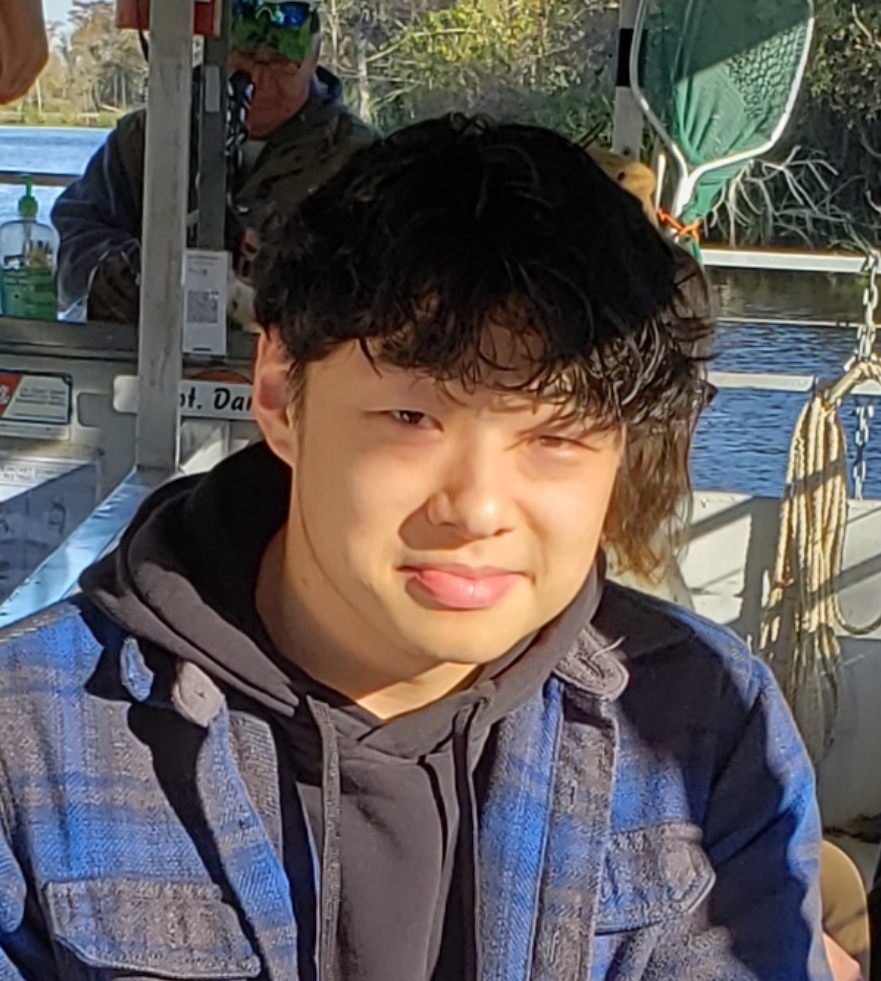
Tianfang Guo
M.S. in Computer Engineering
Texas A&M University
Computer Engineering Systems Group
Advisor: Paul Gratz
Email: tiaguo@tamu.edu
Resume (PDF)
About
Hi, I'm Tianfang Guo. I received my Bachelor's degree from UT Austin, where I studied Electrical and Computer Engineering with a focus on Computer Architecture and Embedded Systems.
My primary interest is computer architecture. I'm currently in the Computer Engineering Systems Group at TAMU, and my advisor is Paul Gratz.
Projects
- Neural Branch Predictor — my semester project for a special topics course taught on branch prediction. (report)
- Computer Architecture Explorer — my Senior Design Capstone Project completed under Prof. Mattan Erez. (details)
- Embedded Laser Tag System — placed 2nd in the Spring 2023 embedded systems competition. (details)
- Sparse GeMM on FPGA — Machine Learning Hardware Architecture project evaluating GeMM algorithms. (report)
- First Embedded Project — a look back at where my embedded systems journey started. (details)
Experience
I could write about all the technical details of my internships, but that's what my resume is for. I think it's more interesting to talk about other things I've learned during my time in the industry.
Texas Instruments — First Internship
My gig at Texas Instruments was my first ever internship. Thus, I was actually woefully prepared for it. But as it turns out, not much is actually expected of a college sophomore.
I learned a multitude of things that summer, not the least of which was that Dallas people don't know how to drive. The true rigidness of a corporate job was also somewhat gently instilled within me. I learned about deadlines, sprints, how badly internal tools are documented; but perhaps most importantly, I learned how to survive this jungle.
Qualcomm — Second Internship
Second times the charm; DV at Qualcomm! This was a big boy internship. I was ready to get things done, network, and conquer the world. What I was actually met with was a mostly empty office, a natural consequence of a 3 day WFH schedule. This desolation of course doesn't speak to the technical rigor of the internship, but perhaps resulted in me working with more independence than I would have liked.
Incidentally, this was also the summer I truly fell in love with Austin. I was at a somewhat tumultuous time in my life, and with relatively more free time on hand compared to during the semester, I turned to exploring the city, which kept me grounded.
Arm — Last Internship
It was during this internship that I truly learned, and comprehended the way that AI has changed, and will continue changing, our industry. These AI coding tools have gotten very good, and are only going to get better. At face value, this seems like a good thing; I will never truly have to worry about implementation ever again. There is no virtue in being a bash wizard, or have in depth, esoteric c++ knowledge. But when you and everyone else, no matter the experience level, no longer need to worry about infrastructure or implementation, it only raises the bar that much higher. As it stands, what value do we provide as engineers? It's in the decisions we make that steer these AI tools; and this means that formal theory and the critical thinking/logic governing these decisions will only become an increasingly larger asset.
Research Interests
My research is in hardware prefetching and computer architecture. I am relatively far away (although not so much so) from something of a completed manuscript for my thesis, so here is a collection of thoughts that provide a general direction for my intents.
A way to quantify prefetching is to compare existing hardware prefetchers to some magical oracle prefetcher. You can do this by analyzing the specific prefetch streams generated by said prefetchers. When you compare these streams, you can generally separate them into four sets:
- Set 1: Prefetches made by hardware prefetchers that aren't made by the oracle. These aren't necessarily incorrect, but are deemed non-optimal by the oracle.
- Set 2: Prefetches made by both. These are simply optimal prefetches and aren't very interesting.
- Set 3: Prefetches made by the oracle that are theoretically possible for a hardware prefetcher to make. We just haven't designed one good enough to make them yet.
- Set 4: Prefetches made by the oracle that are impossible for a hardware prefetcher to make. Likely because the oracle uses future information to make these, which is impossible because Intel doesn't know how to build a time machine.
It is easy to separate Sets 1, 2, and 3+4, but it's much harder to separate Set 3 from Set 4, which is the set we really care about, since Set 3 contains hard-to-make prefetches that can guide future prefetcher design.
The first-order concern is to actually create motivation to do this research. That is, is Set 3+4 actually large enough to justify putting effort into discovering its contents? There are multiple ways to do this, none of which seem (at least to me) particularly more correct than the others. The main point here is to quantify the difference between oracle streams and other prefetcher streams.
One way to do this is via compression, as a proxy for finding the Kolmogorov complexity of the streams. If you can compress a file well, it means there is less entropy in the file. I should add that the point of needing to calculate the entropy/k-complexity is that if a stream has a high amount of entropy, then it is naturally unpredictable. If the oracle stream had high entropy, it would mean the oracle is making seemingly random or unpredictable decisions on what to prefetch using its prescient information. However, according to my data so far, this is not the case—the oracle stream generally has one of the lower entropies across many benchmarks. This means the oracle is actually making relatively more patterned decisions than existing prefetchers. I am currently at this stage, which is to say mainly data collection and analysis.
Next comes the much harder part of actually separating Set 3 from Set 4. Again, there are multiple ways to do this:
- Train an ML model: The rationale being that if the model can generate the prefetch, then it probably belongs in Set 3.
- Create a compile-time dependency flow graph: You can somehow see if you ever get enough information in the form of instructions soon enough to make an accurate prefetch.
- Vector projection (my personal idea): Project each stream as vectors onto some N-dimensional space, and then simply do vector arithmetic on those vectors. We can get the partial vectors that represent the difference between them, and that lets us separate the sets too.
Ultimately, I suspect what's going to happen is some combination of multiple of these methods (conservatively) acting as filters that generates some subset of Set 3.
Coursework
Spring 2026
| Advanced Computer Architecture | Prof. Paul Gratz |
| Special Topics on Branch Prediction | Prof. Daniel Jimenez |
Fall 2025
| Parallel Computing | Dr. Vivek Sarin |
| Intro to Hardware DV | Dr. David Kebo Houngninou |
| Deep Learning and LLMs | Dr. Tomer Joseph Galanti |
Spring 2025
| Hardware Architecture for Machine Learning | Dr. Lizy John |
| Requirements Engineering | Dr. Suzanne Barber |
| UT SEEK |
Fall 2024
| Operating Systems | Dr. Ramesh Yeraballi |
| Digital System Design w/ HDL | Dr. Lizy John |
| UT SEEK |
Spring 2024
| Compilers | Dr. Mattan Erez |
| Algorithms | Dr. Pedro Santacruz |
| Honors Senior Design II | Dr. Frank Register |
| UT SEEK |
Fall 2023
| Computer Architecture | Dr. Mattan Erez |
| Digital Logic Design | Dr. Nur Touba |
| Honors Senior Design I | Dr. Frank Register |
| Public Communication of Science and Technology | Online |
Spring 2023
| Probabilities and Random Processes | Dr. Gustavo de Veciana |
| Engineering Communications | Dr. Bill Fagelson |
| Embedded Systems Design Lab | Dr. Jon Valvano |
| True Crime Podcasts | Dr. Robert Quigley |
| Federal Government | Online |
Fall 2022
| Software Implementation I | Dr. Valleth Nandakumar |
| Linear Systems and Signals | Dr. Jon Tamir |
| Linear Algebra | Dr. Arie Israel |
| Gems and Minerals | Dr. Elizabeth Catlos |
| World Literature | Online |
Spring 2022
| Intro to Embedded Systems | Dr. Lucas Holt |
| Circuit Theory | Dr. Earl Schwarzlander |
| Differential Equations | Dr. Charles Mills |
| Intro to Classical Methology | Online |
Fall 2021
| Intro to Electrical Engineering | Dr. Edward Yu |
| Intro to Computing | Dr. Yale Patt |
| Calculus | Dr. Theresa Martines |
| American Musicals | Dr. Hannah Lewis |
2019-2020 (at LSC)
| Federal Government | |
| Macroeconomics | |
| US History | |
| Intro to Computers | |
| Physics | |
| Calculus | |
| Composition/Rhetoric |